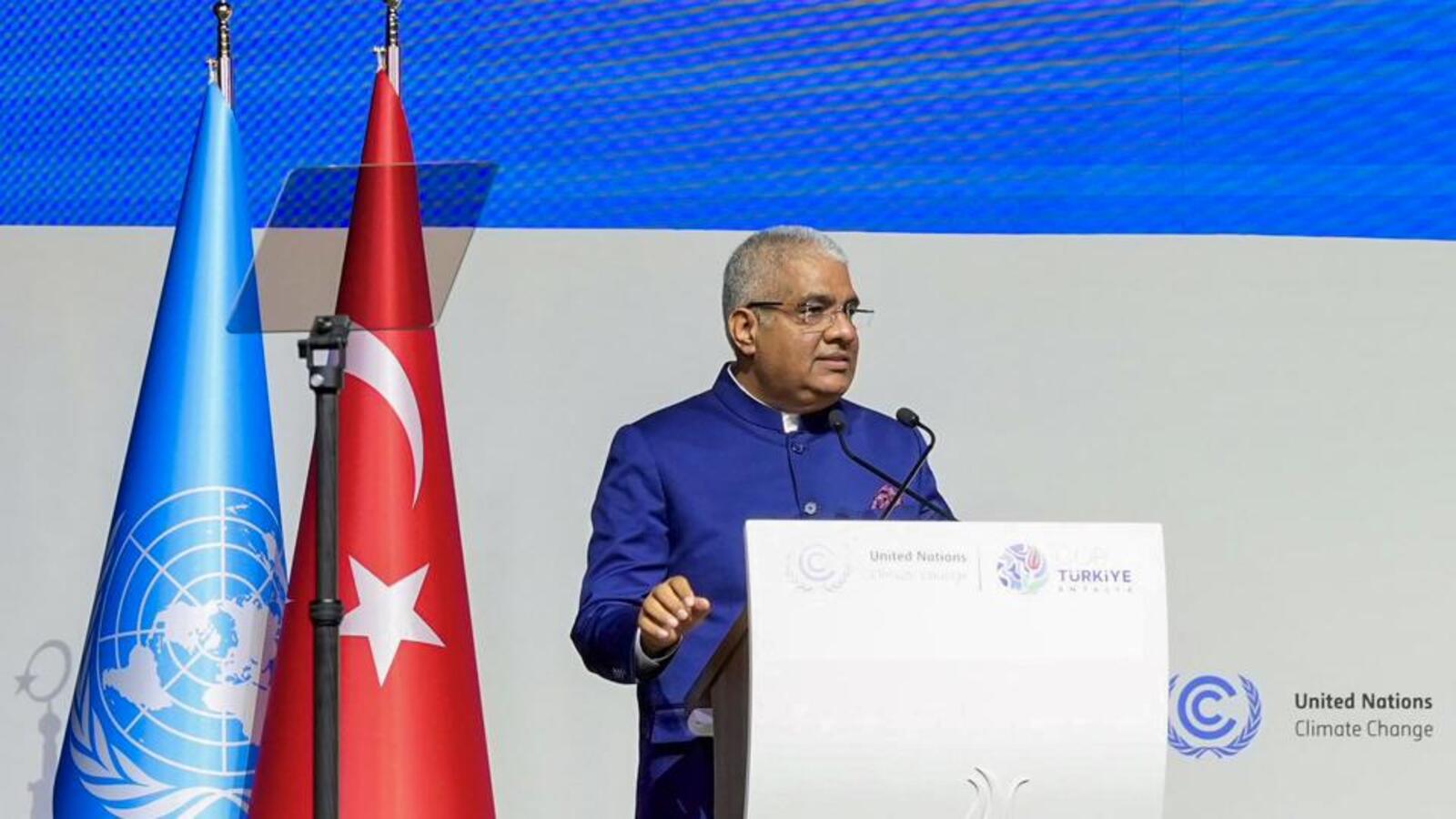
Union environment minister Bhupender Yadav delivered India’s national statement at the UN Climate Change Conference (COP31) in Antalya on Wednesday, stating that the Global South cannot be made to bear the burden of historical emissions in the name of “higher ambition”. He said India’s position is clear that climate action must be rooted in equity, climate justice and the principle of Common but Differentiated Responsibilities and Respective Capabilities (CBDR-RC).
Yadav said expecting the Global South to bear the burden of addressing the consequences of historical emissions in the name of “higher ambition” is unjustified, and that developing countries cannot be asked to choose between climate action and their legitimate right to development, decent living standards, health and education. He described equitable access to the remaining carbon budget as non-negotiable, and said the planet’s warming is the consequence of two centuries of industrialisation and economic growth in some countries, fuelled by unabated greenhouse gas emissions. He added that COP31’s theme of “Dialogue, Consensus and Action” requires honest dialogue and equity-based consensus, with urgent action guiding global climate efforts.
The COP31 presidency on Monday began the second week of the conference in Antalya by issuing a first draft of its “cover decision”, which includes a call for nations to speed up phasing out fossil fuels and a “tripling” of finance for climate adaptation measures in developing countries, while also asking countries to contribute to the presidency’s electrification 35x35 pledge for electricity to make up 35% of global final energy by 2035. The draft is set to undergo several changes before the end of the week as countries agree and disagree on different issues.
Yadav reiterated that decisions taken at COP and their implementation must be firmly rooted in equity and the CBDR-RC principle, which recognises that while all countries share a duty to fight climate change, their obligations must account for differences in historical emissions and economic and technological capabilities. He called for the Mitigation Work Programme to remain “facilitative and non-prescriptive”, the Global Stocktake to continue serving as an instrument for informing Parties, and the Just Transition Mechanism to be anchored in equity. He also said India is against unilateral trade measures which penalise developing countries under the guise of climate action, urged developed countries to honestly and expeditiously fulfil their climate finance obligations, and called for accounting for climatic and demographic changes and technological advancements while shaping contemporary cooperation. India had maintained its opposition to such unilateral trade measures as the European Union’s Carbon Border Adjustment Mechanism even before COP31, with Yadav arguing before departing for Antalya that they could disadvantage developing economies and become barriers to trade. He ended his statement by highlighting India’s progress and saying that under Prime Minister Narendra Modi, India’s Nationally Determined Contributions are fully aligned with the vision of achieving “Viksit Bharat” by 2047 in a sustainable manner.